Most advice on making tool calls reliable is about the interface. Offer few tools. Name them clearly. Say when to use each one. Type the arguments. Make errors say how to recover.
I wanted to know how much each of those buys on models small enough to run on a laptop, and where the failures come from when they happen. So I built an invented company with eight working tools, wrote 120 tasks with checkable answers, and ran three local models through them at temperature 0: qwen3 8B, Llama 3.1 8B and Gemma 3 12B. A 30B qwen3 model with thinking ran the first 60 tasks for comparison.
By the first call, they look ready
Single-call tasks were solved. Every small model completed 92 to 100% of them. On tasks that needed a tool, the first call went to an acceptable tool 78 to 80% of the time, and no model called a tool that wasn't offered.
If I'd stopped there, I would have said these models handle tools.
By the finished task, they don't
Scored on whether the task got done, the three models completed 59%, 36% and 69%.
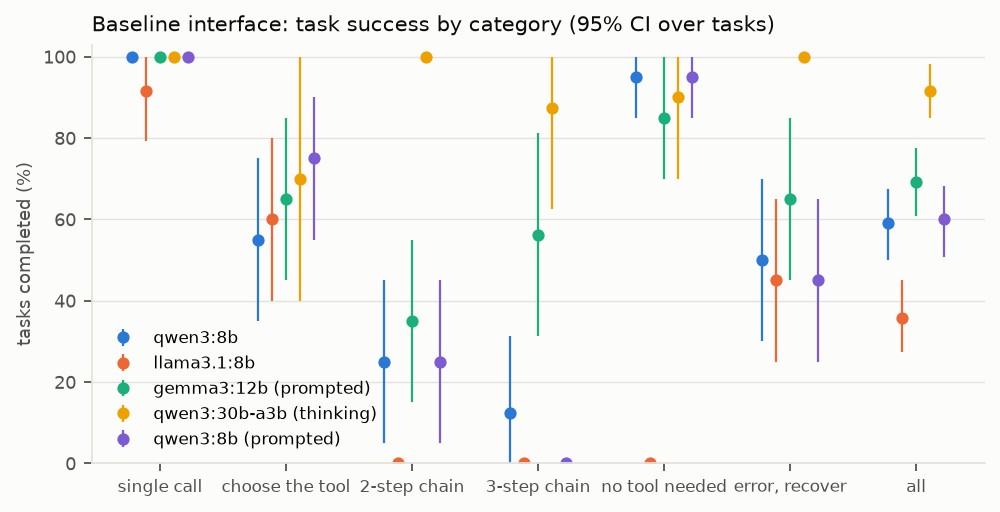
The gap is chains. When the second call needs a value from the first, such as finding who placed an order and then looking up their email, qwen3 finished 25% of two-step chains, Llama 0% and Gemma 35%. On three-step chains it was 12%, 0% and 56%.
Of the 85 failed chains, 74 never called a tool the task needed. About half made the first call correctly and then handed the next step to the user. The rest skipped the lookup and guessed, for example inventing an attendee's email address instead of finding it.
Errors went the same way. When a tool error said exactly how to fix the call, the models recovered 9%, 0% and 36% of the time. Mostly they passed the error on to the user.
Llama had one more problem of its own: it called a tool on 90% of the tasks that needed none. qwen3 and Gemma did that 0% of the time.
The interface barely moved it
Twenty tools instead of eight, terse descriptions, vague near-duplicate names and free-string arguments each moved overall success by under 5 points for every model, none of them beyond the noise floor. One schema result did hold completely, and I'll come back to it in a later post.
The noise floor was zero: the identical baseline, sent again as separate calls, flipped 0 of 120 episodes for each model.
A bigger model closes the loop
qwen3 30B with thinking completed 92% of the first 60 tasks, with every two-step chain and every error task. That is 31.7 points above qwen3 8B on the same tasks. It mixes size with thinking, and it took about 10 seconds an episode against 3.
What I take from it
The hard part was not picking the tool. It was the loop: carrying a result into the next call, and acting on an error instead of reporting it. A tool-use check that only scored first calls would have hidden that. It would have said about 80%.
Limits
Three small open models at 4-bit plus one 30B thinking model, served locally by Ollama, at temperature 0 with one system prompt. The sandbox is invented and tidy, the tasks come from 30 templates, and single categories have 16 to 24 tasks, so their intervals are wide. Nothing here says how hosted frontier models behave. A hand-labelled check of 80 sampled episodes is drawn and not done yet.
The full results are in the case study, and the code is on GitHub. Every number regenerates from cached model calls, so you can check any of it.