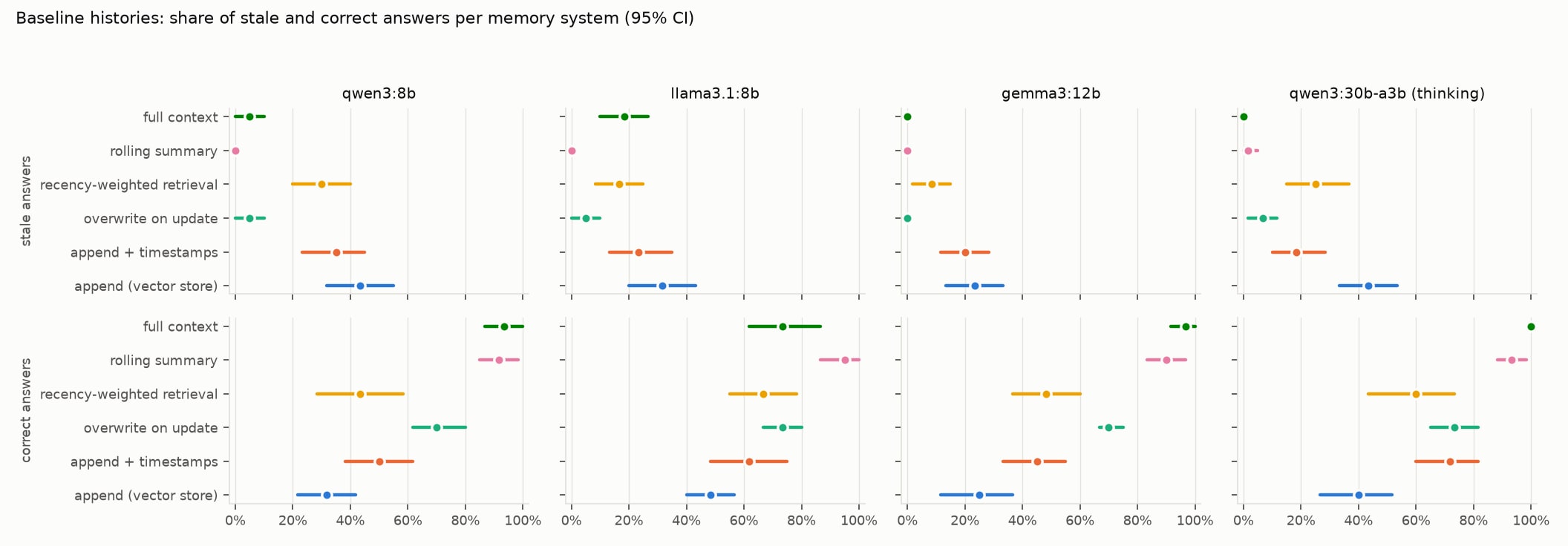
In a study of stale facts in agent memory, the common design, an append-only vector store, gave the old value after one clear update on 23 to 43% of questions, across four local open models. So the practical question is which designs fix that, and what you pay for each.
Every comparison below is against that plain store, on the same baseline questions.
What helped
- Overwrite on update. Before saving a new fact, the writer model sees the most similar existing entries and names the ones it replaces, which are deleted. Stale answers fell by 23 to 38 points.
- Rolling summary. The writer rewrites one short summary of the user after every session. Stale answers fell by 23 to 43 points.
- Recency-weighted retrieval. Newer entries score higher, as in Generative Agents. It helped by 13 to 18 points, mostly by fixing retrievals that held only the old value: those fell from 15% of questions to 3%.
- Dates on each entry. For the 8B and 12B models, only 3 to 8 points, with intervals touching zero. For qwen3 30B, run with its reasoning on, 25 points. It used the dates.
What it costs
- Overwrite needs a second writer call on most sessions: 1.82 calls and 296 writer tokens per session, against 1.00 and 160 for the plain store. And it can lose the new fact. On 13% of questions, the current value wasn't in what it retrieved, mostly because the writer had deleted or dropped the new entry. The store itself lacked it on 8%.
- The summary rewrites itself every session: 278 writer tokens and about 3 seconds of compute each time, measured while another job shared the GPU.
- Dates made the answer prompt longer, 210 tokens against 142.
- Full history in the prompt also did well on explicit updates for three of the four models, at about 6 times the answer prompt (873 tokens against 142). It only works while the history fits.
- Recency weighting needed no extra writer calls.
None of them handles implied updates, where the new value is only mentioned ("the commute here in Austin"). The summary went from 0% to 20 to 27% stale on those.
Predictions I got wrong
I wrote my predictions down before the full run, after a small pilot, and corrections go in dated addenda. Several were wrong:
- I expected the plain store to be stale on at least 25% for every model. Gemma 3 12B was at 23%.
- I expected the full history to be stale on 15% or less. Llama 3.1 8B was at 18%.
- I expected recency weighting to get worse as the update got older. For qwen3 8B it was 18 points less stale at 20 sessions than at 0. But answers naming neither value rose to 25% at 20 sessions, so it wasn't simply getting better.
- I expected recency weighting to help less than dates. For the 8B models it helped more.
- I expected the summary to hedge more than the plain store. It hedged on 5 to 10% of questions, against 13 to 48%.
- I expected the 30B model to be less stale. On the plain store it was at 43%, the same as qwen3 8B. With dates, it was.
The ones that held: repetition drives staleness, recency matters little for similarity search, a second update makes the plain store worse, and overwrite and summary are the strongest fixes.
Limits
The 30B model ran only with reasoning on and on a reduced grid, so size and reasoning are tangled for it. These are small 4-bit models on synthetic histories, so the costs are relative, not a benchmark.
The full study is in the case study, and the code is on GitHub.