Prompts get reworded all the time, usually for reasons that have nothing to do with the task: someone tidies the instruction into bullets, adds "please", moves it into the system message. None of that should change the answer. I wanted to know how often it does.
So I took 300 items whose answers code can check: 100 maths word problems from GSM8K, 100 multiple-choice questions from MMLU, and 100 restaurant descriptions to pull five fields out of as JSON. Three open models ran them locally at temperature 0: qwen3 8B, Llama 3.1 8B and Gemma 3 12B. Each item got a base prompt and 10 to 12 rewordings, each changing one thing. Tomorrow's post is about how that was set up.
Small per rewording, large per item
Averaged over all rewordings, the answer changed on 4.7% of items for qwen3, 7.8% for Llama and 4.8% for Gemma. That sounds small until you look per item. Across all the wordings, 16%, 27% and 18% of items got more than one distinct answer, and 15 to 24% were right under some wordings and wrong under others.
The server isn't the cause. Sending the base prompt a second time, as a separate call, changed 5 of 900 answers, all of them long worked maths solutions.
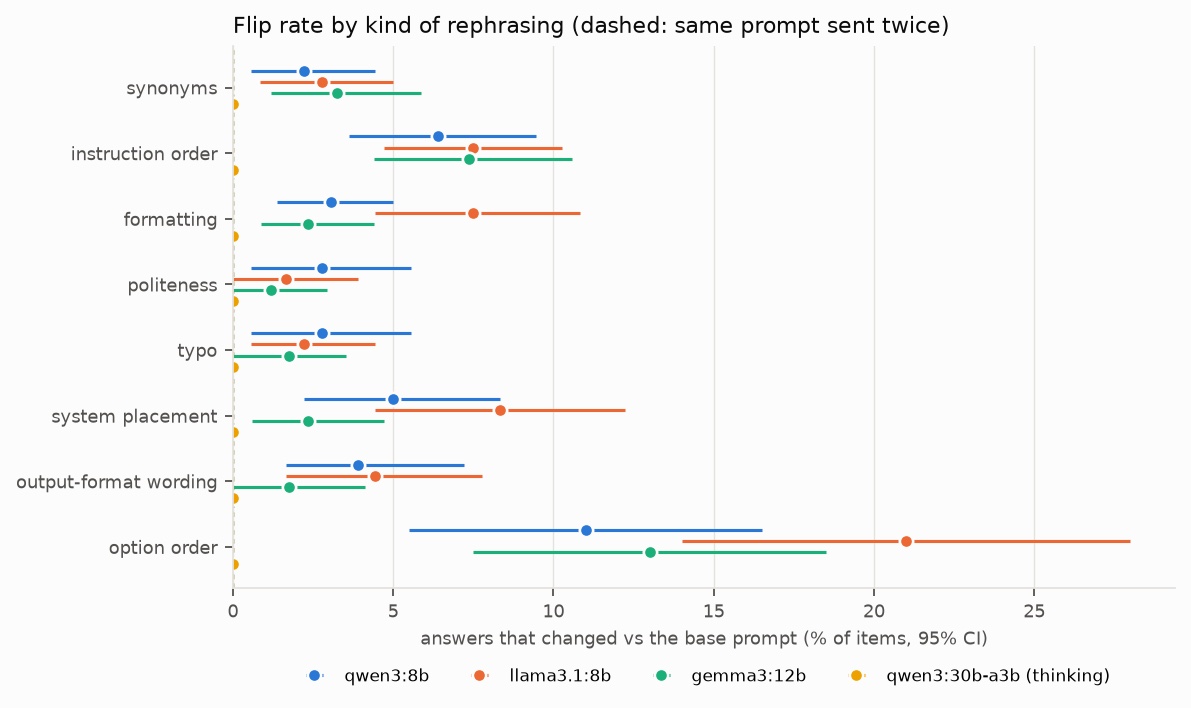
Option order moves the most
Shuffling the multiple-choice options, with the answer key remapped so the right answer is the same text, changed 11% of answers for qwen3, 21% for Llama and 13% for Gemma. Nothing else came close. Next was the order of the instruction, at 7 to 9%. Moving the instruction word for word into the system message changed 10% of Llama's answers. Politeness and a single misspelt word moved 2 to 6%, which is small but above the repeat for most models.
Each task has its own weak spot
Maths moved the most overall: with the three models averaged, most kinds of rewording changed 6 to 10% of answers, since a long worked solution has many places to go differently. Multiple choice was steady except for option order, at 15%. Extraction barely moved, with one exception. Putting the description before the instruction changed 14 to 18% of extraction answers and cost accuracy: 10 points for qwen3, 4 for Llama and 16 for Gemma, with qwen3's and Gemma's intervals excluding zero.
Sideways, not down
Here's why this hides in a normal eval. The changes went both ways. Right to wrong and wrong to right were about equal: 1.8% against 1.8% for qwen3, 2.1% against 2.9% for Llama, 2.3% against 1.2% for Gemma. Net accuracy moved by about a point at most. An accuracy number on one wording looks stable while a sixth to a quarter of the items underneath it are in play.
Limits
Small open models, 4-bit, at temperature 0 on one machine. Each kind of rewording is one or two concrete rewrites, so "politeness" means these two sentences, not politeness in general. Extraction is graded by exact match, and 28% of its changed answers differ only by a generic word, such as "English food" against "English".
The full results are in the case study, and the code is on GitHub. Every number regenerates from cached model calls.