Yesterday's result was that a rewording which shouldn't matter changes the answer on 5 to 8% of items. A number like that is only worth something if the rewordings really didn't matter and the grading is right. Here's how the study checks both.
Tasks code can grade
Every item has one right answer that code can check: the final number of a GSM8K maths problem, the letter of an MMLU multiple-choice question from four high-school subjects, and five fields pulled from a restaurant description in the E2E dataset, as JSON. Items were drawn with a fixed seed from public test sets, 100 per task. Ten more per task were a pilot, used to check the prompts and the answer parser on real outputs, and are left out of every number.
One change at a time
Each item has a base prompt, and each rewording changes exactly one thing:
- Synonyms: a few instruction words swapped ("Solve" to "Work out").
- Instruction order: the item before the instruction, or the instruction's sentences reversed.
- Formatting: the instruction as bullets, or the answer marker shortened.
- Politeness ("Please ... Thank you!") and one misspelt instruction word. The item is never touched.
- System placement: the instruction moved, word for word, into the system message.
- Output-format wording: the format sentence reworded.
- Option order, multiple choice only: options reversed or shuffled, with the key remapped.
Tests check every rendered prompt: the item appears verbatim, each option appears once and the remapped key points at the right text. The report also lists every rewording's accuracy change for every model, because a rewording that changed the question should cost all of them. None did with an interval below zero for all three.
The floor, and the rule
The base prompt is also sent a second time, as a separate call with its own cache entry, spread through the run. That repeat changed 5 of 900 answers. A kind of rewording counts as having an effect only when its flip rate minus the repeat's, on the same items, has a 95% interval above zero.
A flip is any change in the parsed answer, including to no answer. The parser takes the answer after an "Answer:" line and falls back to a few other patterns. One labelling pass, done without seeing the parser's answers, agreed with it on 50 of 50 random outputs and 20 of 20 that needed a fallback rule.
Which way the answers moved
A flip can go either way, so the study counts both directions.
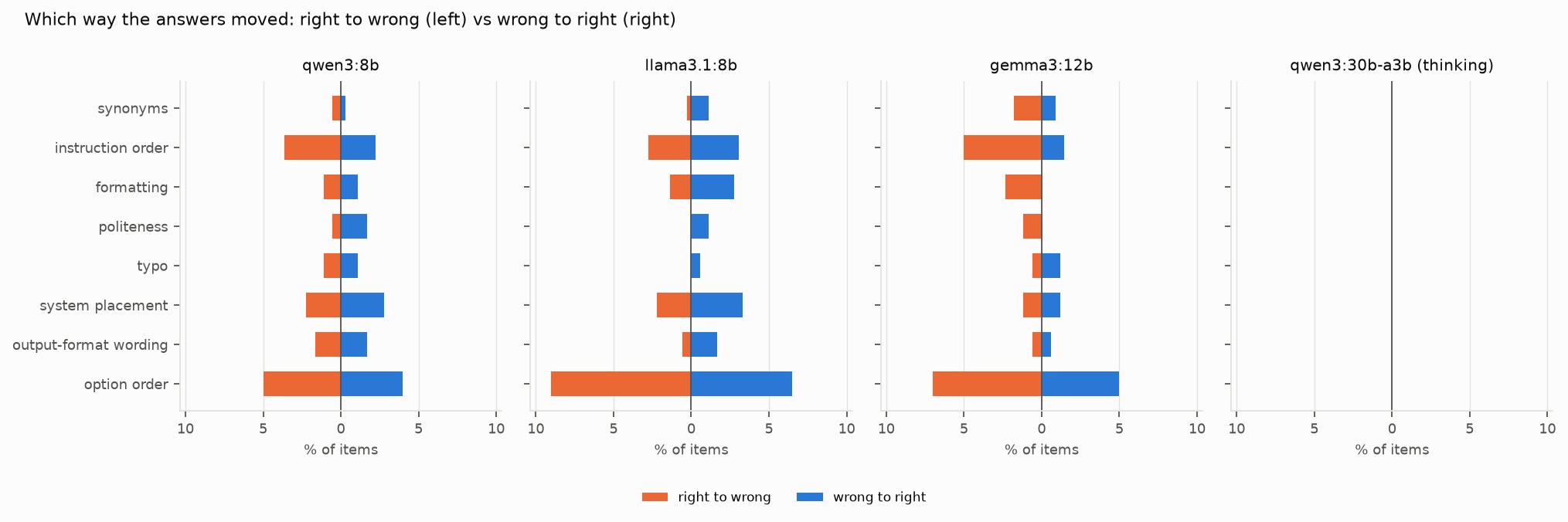
The two sides roughly balance, which is why accuracy barely moved. The asymmetry is in which items move. An item the base prompt got right went wrong under a rewording only 2.0 to 2.5% of the time. An item it got wrong was fixed 16 to 20% of the time. The wording pushes around the items a model is unsure about.
Two runs
The first run was cut short when the laptop slept on battery, so I published a smaller grid in October. The full grid ran a week later on the same seeded items, reusing every cached call: 12,800 calls in all. The predictions were committed before the full run and not changed. I had read the first run's results, though, and they cover 180 of the 300 items. The full run held the earlier findings. The one thing that changed was the floor, from zero to those 5 answers.
Limits
Small 4-bit models at temperature 0, one seed, one machine. One labelling pass, by the person who wrote the parser. Each kind of rewording is one or two concrete rewrites, not all possible ones.
The full design is in the case study, and the code, prompts and cached calls are on GitHub.