In a long-context study I ran, the result that bothered me most wasn't how often the models missed a fact. It was what they said instead.
The setup: an invented fact ("who designed the Briskhaven Lighthouse?") planted in Wikipedia text from 1k to 16k tokens, and in some runs three near misses nearby. Those are facts about the Briskhaven Viaduct, the Briskstone Lighthouse and the Vellhaven Lighthouse, each naming a different person. Three local models, qwen3 8B, Llama 3.1 8B and Gemma 3 12B, at temperature 0.
Wrong answers weren't made up
With the look-alikes in place, recall dropped. But not one reply in those cells invented a name. A wrong reply named a look-alike's person, now and then alongside the right one, or said "not stated".
Gemma never said "not stated" when the fact was there. Every miss named a look-alike's person, and at 16k that was 48% of its replies.
Usually the one that came first
When a reply named a look-alike, which one? For the two 8B models, mostly one placed before the real fact: 87% of the time for qwen3 (99 such replies) and 82% for Llama (196). If they had picked one of the three at random, the expected share would have been 63% and 65%, because of where the real fact sat.
Gemma was close to random, 63% against 59%. So it isn't a rule about all models. For two of the three, the first thing that looked right tended to win.
Then I took the fact out
This is the part that matters most for anyone building on retrieval. I removed the key fact from a 4k document, so the right reply is "not stated".
With nothing similar in the document, the models got this right: 100% for qwen3 and Llama, 98% for Gemma. With the three look-alikes there and the real fact still missing, Gemma named one of their people on 98% of items. qwen3 did on 57% and Llama on 50%.
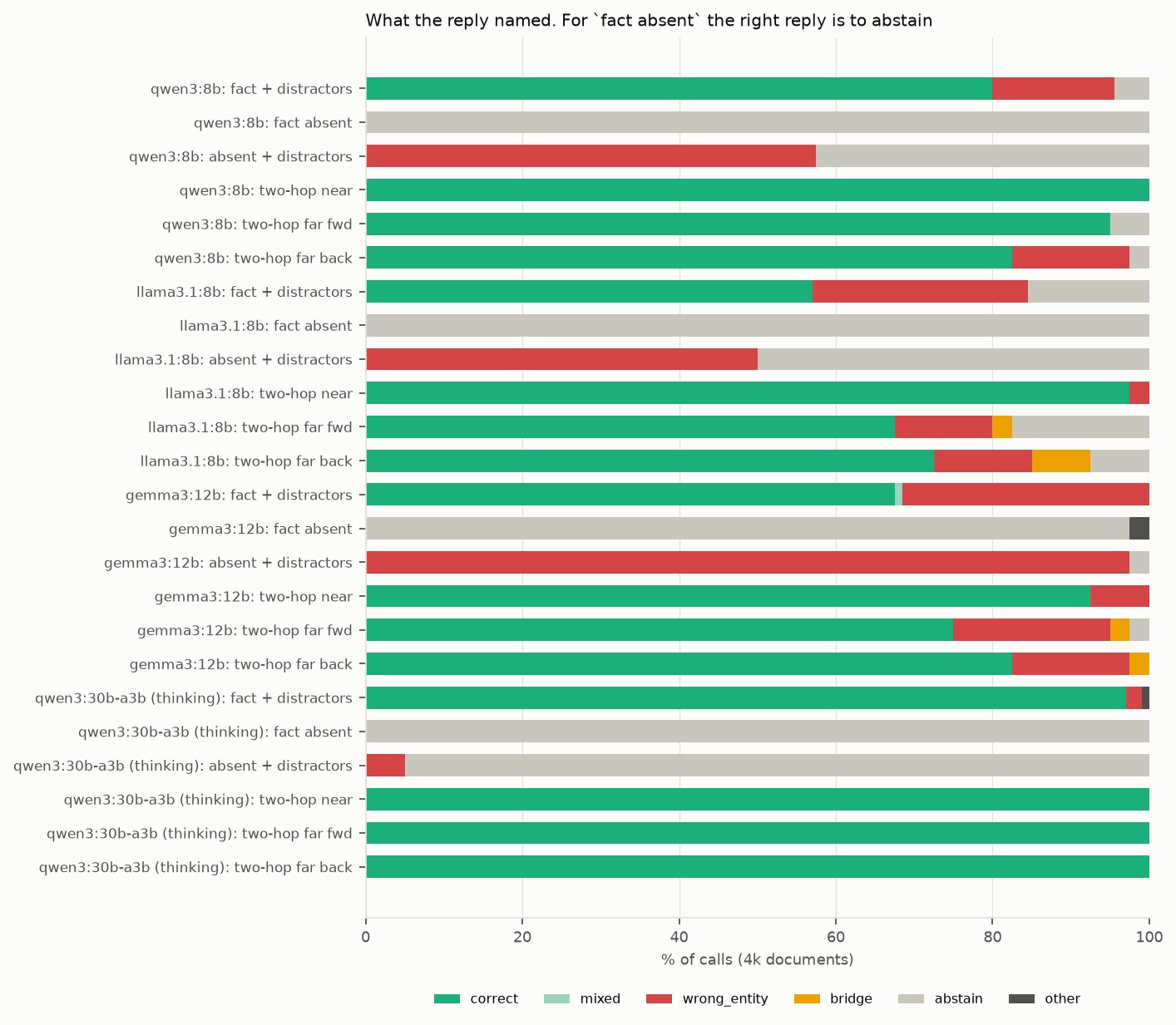
A model that says "not stated" on an empty page can still fill the gap from something that looks close enough.
The one exception was qwen3 30B with thinking, run on 20 items: it named a look-alike on 1 of 20 with the fact left out. That mixes size with thinking, on few items, and it took about 7 seconds a call against 3.
Why this matters for RAG
I didn't test a retriever here, so this is an inference, not a result. But a retriever returns the passages most similar to the question. When the right passage isn't among them, the ones that are will often be its look-alikes: the same product name with another version, the same clause from another contract. That is the exact condition where these models answered with a wrong name instead of saying they didn't know.
So a test of "does it say not stated when the answer is missing" should be run with near misses in the context. Without them, every model here passes.
Limits
The fact-absent condition ran at 4k only, on 40 items. The near misses are one hand-written kind: similar names, same relation. These are small 4-bit models run locally at temperature 0, and the answers were graded by code. A hand check of 80 sampled replies is drawn and not yet labelled.
The full study is in the case study, and the code is on GitHub.