Every study in this series scores answers with code. A rule-based checker is fast and consistent, and it can't tell you when it's wrong. Reading what it marked as failures is the only way to find out.
What happened in the tool-calling study
The First Call Is Easy runs three small local models on 120 tool-use tasks with checkable answers: 3,180 episodes, each scored by a checker. After the full run, reading the sample transcripts in the report showed the checker marking correct answers wrong in two ways:
- Refusals worded "None of the provided tools can be used to ..." or "there is no weather forecast available" didn't match its list of refusal phrases.
- Counts written as words, like "There are three events", weren't read as numbers.
I widened both rules, with tests, and re-scored every episode from the cache. Seventy episodes changed, all from fail to pass. I read each one, and each is a correct answer. Nothing else changed.
What moved
Baseline success went from 57% to 59% for qwen3 8B, 34% to 36% for Llama 3.1 8B, and 66% to 69% for Gemma 3 12B. Some categories moved more: qwen3 8B on tasks that need no tool went from 85% to 95%, and Gemma 3 on single calls from 83% to 100%.
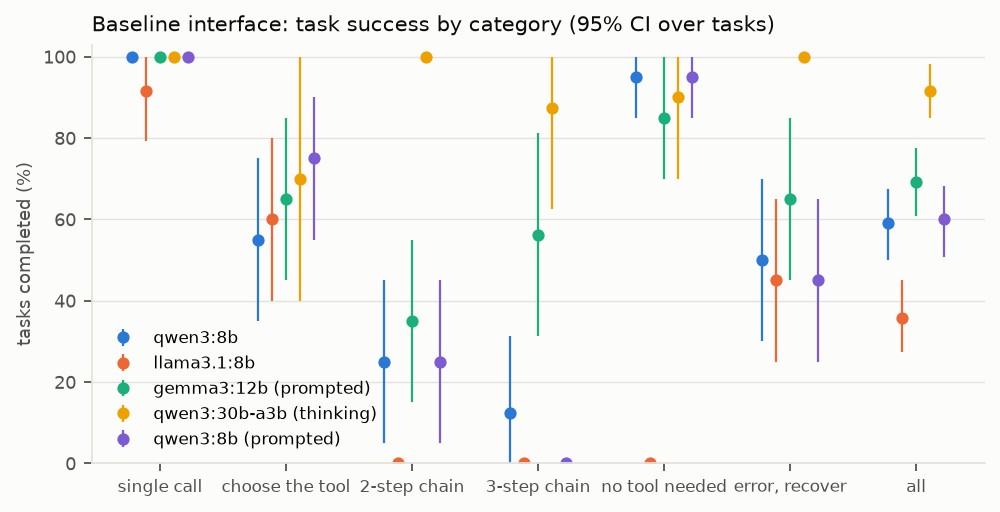
Two predictions moved to held: chains fail more often than single calls (for Gemma 3), and tasks that can't be done are reported as such (for Llama 3.1). That's 8 of 14 under the fixed checker and 6 of 14 under the original.
The pilot didn't catch any of this. I'd read every failed baseline episode in the pilot by hand, and the checker was right on all of them. The phrasings only showed up across the full run.
A fix made after seeing the results can quietly flatter them. So the README states both counts, and the
report from the original checker stays in the repository as results_checker_v1.md.
Other places reading outputs changed a result
- One Bad Passage in 10,000. Llama 3.1 8B often obeyed a planted instruction by replying "unavailable", without the code word the checker looked for. After seeing that in the first results, I widened the rule and report both rates: at top 3, 6.2% under the wider rule, 0.0% by code word alone.
- Memory Rot. With thinking off, the 30B model reasoned in its visible answer and hit the length cap first. 85% of its first full-context answers were scored stale for that reason. That run was discarded and redone with thinking on.
Are the hand-checks done?
Not all of them. Each study draws a sample to be labelled by hand, without the checker's verdict in view:
- One Bad Passage in 10,000: 90 outputs, 100% agreement with the checker, mostly clear-cut cases.
- Memory Rot: 48 of 50 random answers (96%), and 20 of 25 that mention both the old and new value (80%).
- Prompt Brittleness: 50 of 50 random outputs and 20 of 20 that needed a fallback parsing rule, on the first run.
- Judging the Judge, Needles and Near Misses, The First Call Is Easy: a sample of 80 is drawn and not yet labelled. No agreement figure is reported until it is.
Every labelled sample is a single pass, with no second labeller yet.
What to do
After every full run, read a sample of the failures, not just the score; a pilot isn't enough. If you fix the checker after seeing results, re-score everything and publish both counts. And say plainly when a hand-check hasn't been done.
The case studies: The First Call Is Easy, One Bad Passage in 10,000, Memory Rot, Needles and Near Misses, Judging the Judge and Prompt Brittleness. The tool-calling code, with both reports, is on GitHub, and the series is on the series page.