When an agent's memory holds both an old fact and a new one, two things could decide which one wins: how often each was said, and how recently. I tested both, one at a time, on fictional users whose facts change over many short sessions, with four local open models and seven memory designs. Each condition has 60 questions, and every answer is checked by code.
One of the two mattered a lot. The other barely mattered at all.
Repetition
In the baseline, the old value is stated three times before it changes. I also ran it with the old value stated once, and ten times, and nothing else different.
For the plain append-only vector store, going from one statement to ten raised stale answers by 57 to 60 points for every model. For qwen3 8B, that's 25% stale to 85%.
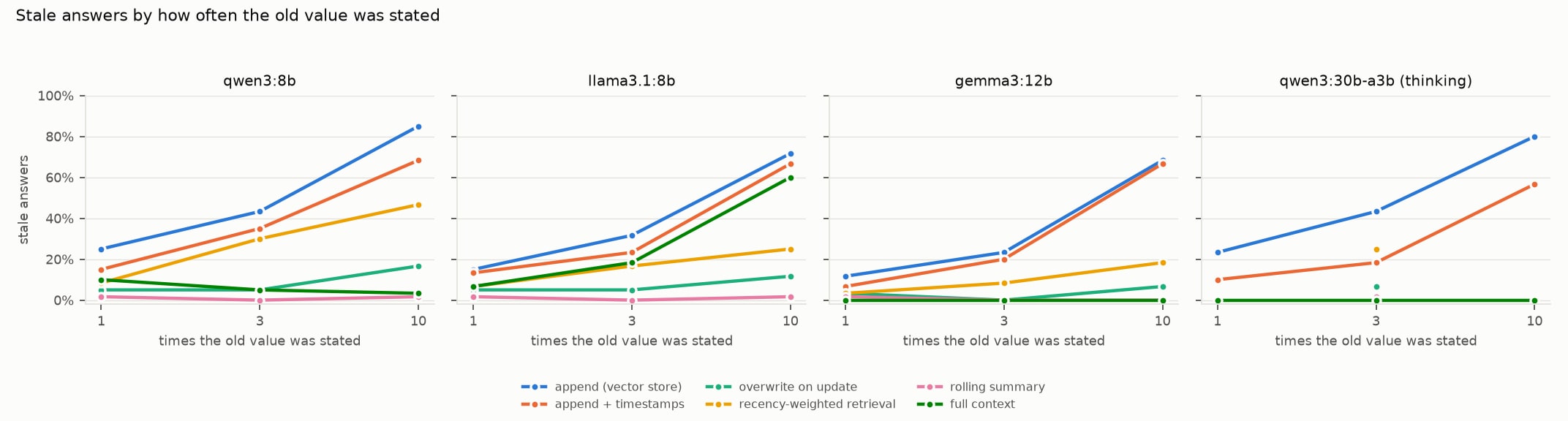
Putting a date on each memory didn't protect against it. The timestamped store rose by 47 to 60 points too. The dates were right there, and the models still went with the fact they had seen more often.
What did protect: designs that keep one current version of each fact. For overwrite-on-update, the repetition effect was 3 to 12 points, and none of it cleared the noise floor. For the rolling summary it was zero or close to it.
One more thing sits in the chart. For Llama 3.1 8B, even the full history in the prompt went from 7% stale at one statement to 60% at ten. Seeing every word didn't stop the old value from winning.
Recency
Then the other factor. Asking 20 sessions after the update instead of right away changed the append store's stale rate by 5 to 7 points. That's inside the rewording noise of up to 10 points, so by the rule I set before the run, it doesn't count.
That fits how the store works. Similarity search ranks memories by how well they match the question, and time isn't part of that. Ten mentions of the old city give it ten chances to match. Unless the design adds time on purpose, how long ago the change happened gets little say.
Implied updates
Most real updates aren't announced. People don't say "update: I moved to Austin." They mention the commute in Austin. So one condition phrased the new value exactly like an ordinary statement, with nothing marking a change.
That broke even the full history. With every session in the prompt, qwen3 8B answered with the old value 72% of the time and Llama 3.1 8B 90%, up from 5% and 18% with a clear update. Gemma 3 12B went from 0% to 25%. The rolling summary went from 0% to 20 to 27%. The 30B model wasn't run on this condition.
If you're building memory
- Count restatements, not just recency. A fact said many times will crowd out its replacement in a similarity search.
- Resolve contradictions when writing, not when answering. Overwrite-on-update barely moved with repetition.
- Don't expect dates on entries to fix it for small models.
- Test implied updates. They hurt most designs here, the full history included.
Limits
Small 4-bit local models at temperature 0, synthetic templated histories, ten users per condition. The point is the direction and the size of each factor, not production rates.
The full study is in the case study, and the code is on GitHub.