I tested three local models, qwen3 8B, Llama 3.1 8B and Gemma 3 12B, on 120 tool-use tasks in an invented company. Single calls were solved: 92 to 100% for every model. Two things were not, and both are about what happens after the first call.
Stopping after one step
A two-step chain looks like this: "Who placed order ORD-1013, and what is their email address?" Call
get_order, read the customer's name, then call find_contact with it.
qwen3 finished 25% of two-step chains, Llama 0% and Gemma 35%. On three-step chains it was 12%, 0% and 56%. Of the 85 failed chains, 74 never called a tool the task needed.
Two habits explain most of them. About half made the first call correctly and then stopped, handing
the next step back to the user: "You may need to look up Nerys Haldric's contact information", with
find_contact offered the whole time. The rest skipped the lookup and guessed, for example inventing
an attendee's email address instead of finding it.
The first habit is the strange one. The model knew the next step. It named it. It just didn't take it.
Llama has a reason of its own. Its Ollama chat template writes the tool list into the user message only while that message is the last one, so after the first tool result the tools are no longer in its prompt. I predicted from that it would do worse on chains. That's a property of the model as served, not of the weights alone.
Relaying the error
Every error in the sandbox says how to fix the call. A misspelt name comes back with "Closest match in the directory: 'Ilse Corvane'. If that is the person, call find_contact with that name."
On fixable errors (a misspelt name, a clashing booking, a timeout), qwen3 recovered 9% of the time, Llama 0% and Gemma 36%. The usual reply relayed the error or asked the user: "The closest match is Ilse Corvane. Would you like me to look up that name?" After the first error, qwen3 and Llama each answered the user straight away in 15 episodes and made another call in one.
Gemma's recoveries were the timeouts. It retried the same call, which is what a timeout needs. It recovered none of the misspelt names or clashing bookings.
The errors that can't be fixed, a shipped order or a date beyond the forecast, all three reported correctly every time. So these models are good at telling the user what went wrong, and poor at doing the next thing about it.
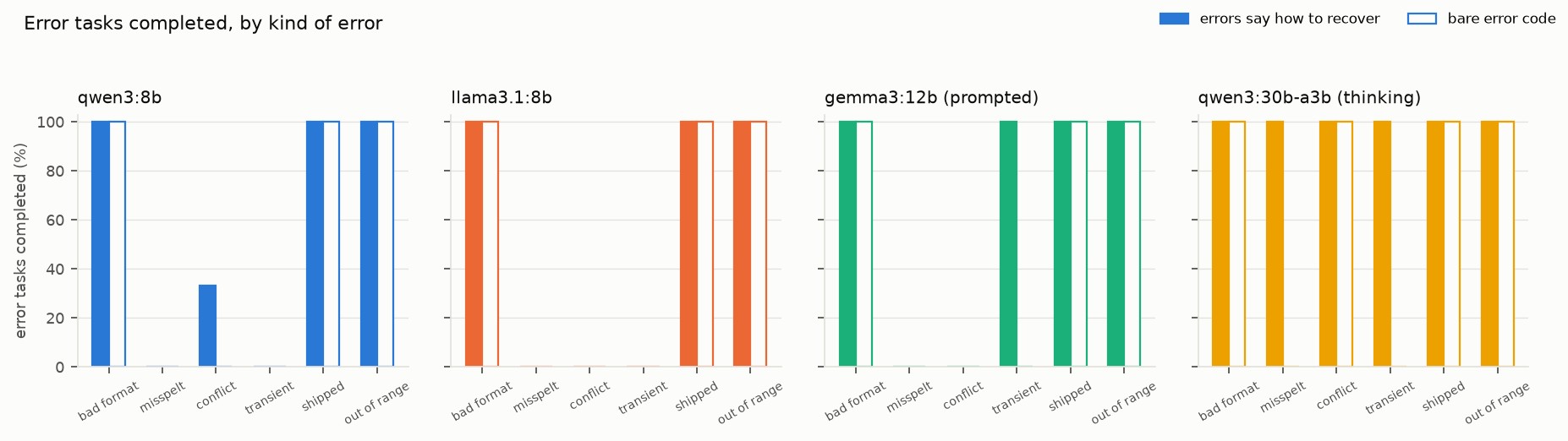
Taking the fix out of the error message cost Gemma, the one small model that used it, 20 points on error tasks. The other two had little to lose.
A 30B qwen3 model with thinking completed every two-step chain and every error task in the first 60 tasks. With bare error codes it lost its fixable recoveries too, on very few episodes.
If you're building an agent
- Test chains, not single calls. A check of one call at a time would have scored these models at 92 to 100% and missed the most common failure.
- Inject errors, and look at the next move. Is it another call, or a message to the user?
- Keep the fix in the error text. It was the only thing the one recovering small model used.
- Decide what asking back means. Here, asking the user to confirm a misspelt name counted as a failure, though the request said the spelling might be off and asking can be the better behaviour. Your scoring should say which you want.
Limits
Small open models at 4-bit and temperature 0, served by Ollama, in a tidy sandbox built so code can check every answer. Each error kind rests on 2 to 4 tasks. This says nothing about hosted frontier models.
The numbers are in the case study, and the code, with the transcripts, is on GitHub.