The usual advice for tool interfaces is easy to list: few tools, clear names, descriptions that say when to use each one, typed arguments, errors that say how to recover. I tested each piece by taking it away from a baseline that had all of them, one at a time, on the same 120 tasks, for three local models: qwen3 8B, Llama 3.1 8B and Gemma 3 12B.
What I predicted
Before the run I committed predictions to git. Twenty tools instead of eight would lower success for at least two models. Vague names would hurt, and more than terse descriptions. Free-string arguments would lower the share of tasks whose calls all had the right arguments. Bare error codes would hurt on error tasks for at least two models. Three tools instead of eight would make no difference.
None of those five held.
What happened
Twenty tools, terse descriptions, vague near-duplicate names and free-string arguments each moved overall success by under 5 points for every model, none beyond the noise floor.
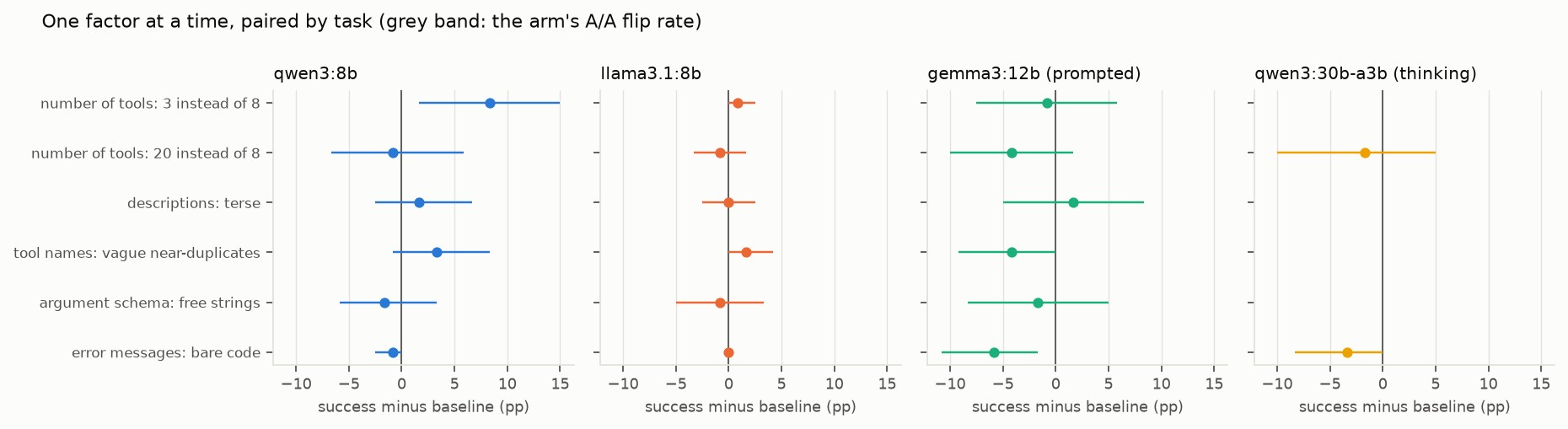
Two changes did count. Three tools instead of eight helped qwen3 by 8.3 points, the opposite of my prediction. Bare error codes cost Gemma 5.8 points overall and 20 on error tasks; it was the one model that used the fix in the message.
Inside single categories, a few changes moved more. Twenty tools cost qwen3 20 points on the tasks where the wording doesn't match the tool. Those are groups of 16 to 24 tasks with wide intervals.
My reading: the failures that mattered were in the loop, carrying a value into the next call and acting on an error, and none of these changes touch the loop.
The schema result that held
Four tasks name an order by its bare number. The tool needs ORD-1043.
With the id format in the schema, every model wrote ORD-1043 itself and succeeded on all four. With free-string arguments, all three sent the bare number, got an error that said exactly how to fix it, and replied to the user instead of retrying, in all 12 episodes.
Four tasks is a small sample, but the effect was complete. And it fits the rest of the study: these models mostly don't act on an error that explains the fix, so a schema that stops the bad call before it happens is worth more than a good error after it.
What a tool-use eval should score
- Finished tasks, not first calls. The first call was right about 80% of the time for all three small models. Tasks were done 36 to 69% of the time.
- Chains of two and three calls. That is where the small models stopped.
- Injected errors, fixable and not. Then score what the model does next.
- Requests that need no tool. Llama called a tool on 90% of them.
- The same run twice. Here the identical baseline flipped 0 of 120 episodes per model, which made every other difference easier to read.
- The checker itself. Reading failures after this run turned up 70 correct episodes my checker had scored wrong; an earlier post in this series covers that.
Limits
Small open models at 4-bit and temperature 0, plus one 30B thinking model, served locally by Ollama, in an invented sandbox. Each condition changes one thing from a good baseline, so combinations aren't tested, and a weaker baseline could give different effects. Nothing here is about hosted frontier models.
The numbers and intervals are in the case study, and the code is on GitHub.